Meet our Authors
Have you ever felt compelled to put thoughts to paper?
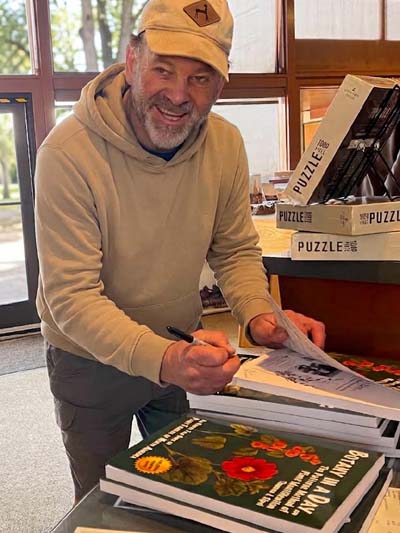
The gift and curse of being an author is to become so utterly consumed with a topic or idea that the interest can only be satiated through writing.
It is a gift to transform one's innermost thoughts into tangible books that allow other people to benefit from your insights. It is a blessed curse to spend thousands of hours writing, revising, editing, and formatting to move a project across the finish line from initial inspiration to polished work.
Writing is one way of making sense of the world. We observe, wonder, explore, and eventually try to put what we have learned into words. An author is simultaneously the storyteller and the reader, the teacher and the student. The process of writing transcribes ideas that are well-formulated, while raising new questions that must be answered. Whether writing a field guide or a novel, the process of writing becomes as transformative for the author as the reader.
We invite you to meet the authors and explore the ideas, stories, discoveries, and adventures that have found their way onto the published works of HOPS Press LLC.
Thomas J. Elpel | Kris Reed | Jan Elpel
Thomas J. Elpel
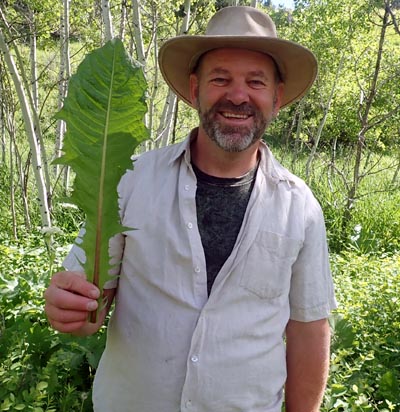 Concerned about environmental issues since childhood, Thomas J. Elpel has made it his life's work to understand, promote, and build a truly sustainable civilization. The task isn't all that difficult from a technical standpoint. We have the necessary technology, and it is typically more economical to go green than to continue living the way we are now. We can increase our individual and collective health and prosperity by building a sustainable, green economy.
 Yet, somehow, experts and lay persons remain trapped in an old way of doing things, unable to see practical alternatives. Professors and politicians sometimes formulate abstract theories about how to shift our civilization in a more sustainable direction, and it looks good on paper, but in the real world, they remain hopelessly dependent on an unsustainable industrial infrastructure. At the end of the day, they go home, turn up the thermostat, eat a meal imported from thousands of miles away, and make plans to rip out and replace all the old carpeting in the house.
 Tom's investigations began in the Stone Age, exploring primitive skills and how to meet one's needs for shelter, warmth, water, and food with the most basic resources at hand. Tom recognized that it wouldn't be possible to abandon civilization and sustain the current world population as hunter-gatherers foraging in the woods. But Tom also recognized that these kinds of experiences are critical for maintaining our connection to the real world. After all, creating a sustainable civilization is ultimately rooted in survival skills and the quest to provide shelter, warmth, water, and food for all. His books Participating in Nature, Foraging the Mountain West, Botany in a Day, and Shanleya's Quest speak directly to this need to rekindle our connection with the natural world.
 At the same time, Tom recognizes that we cannot change the world by merely encouraging people to appreciate nature more. It is essential to connect the dots from nature education to sustainable living. Driven in part by the necessity to meet his own survival needs as a young adult, Tom built a passive solar stone and log home on a shoestring budget - and later switched over to solar power to generate electricity.
He demonstrated that it is still possible to achieve the American Dream - to own a quality home without a mortgage or big utility bills, as detailed in his book Living Homes. Tom expanded on that theme in Green Prosperity, demonstrating that sustainable living can be far more economical and profitable than the way our society operates today.

 It is illogical that our society should continue to do things the hard way, when there are more economical, greener alternatives. This conundrum led Tom to research worldviews and perceptions of reality to try and understand why people are often unable to see answers that seems obvious once you know what to look for. This research led to his most far-reaching book Roadmap to Reality: Consciousness, Worldviews, and the Blossoming of Human Spirit. As Tom has discovered, creating a sustainable civilization is relatively easy. The challenging part is helping people to see beyond their normal expectations to see what is truly possible.
Through his articles, classes, books, and videos, Tom continues to dedicate his life towards the effort to re-unite people with nature and create a sustainable civilization.
Go to: Books by Thomas J. Elpel
Read More: Thomas J. Elpel Biography
Kris Reed
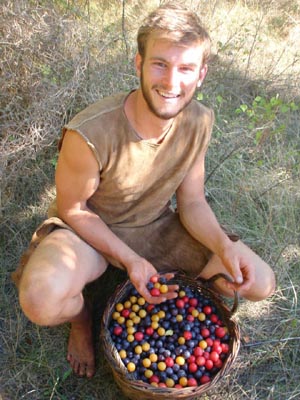
Kris Reed arrived at Green University® LLC as a student in March of 2006, a few months before his nineteenth birthday. Kris came with a passion for primitive skills, which quickly spread to an equal interest in botany, wild food foraging, house-building, and consciousness.
Upon graduating from GU, Kris stayed on to co-teach primitive skills for public schools through Outdoor Wilderness Living School, LLC (OWLS). Kris has a quiet and unassuming grace. As an instructor he doesn't present himself as teacher and possessor-of-knowledge, but rather as a friend sharing knowledge, or as a mentor facilitating the exploration and discovery of new ideas.
Above all, Kris grew to become part of the Elpel clan, journeying together on wilderness survival adventures or car camping with the family. Kris even took Tom's son Donny on an extended canoe trip down the Colorado River from the Hoover Dam to Yuma, Arizona.
 Kris assisted Tom Elpel with the Classroom in the Woods DVD and co-hosted Volume 4 in the Art of Nothing Wilderness Survival Video Series, Canoe Camping: on a song and a paddle. Kris also helped create the card games that go with Shanleya's Quest: A Botany Adventure for Kids Ages 9 to 99, and he discussed ideas with Tom through much of the writing of Roadmap to Reality. Kris Reed ultimately co-authored Foraging the Mountain West: Gourmet Edible Plants, Mushrooms, and Meat. Be sure to read Kris Reed's Adventure Journals.
Go to: Foraging the Mountain West
Jan Elpel
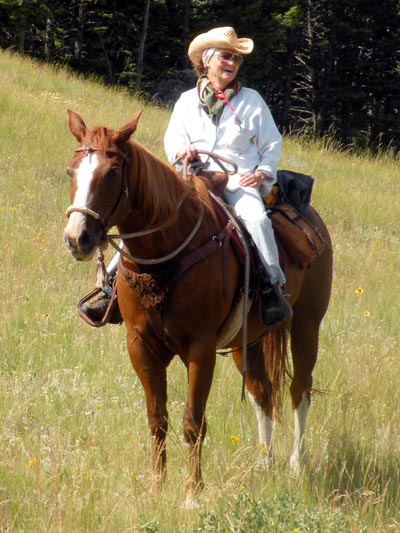
Jan Elpel, Psy.D, grew up near the Headwaters of the Missouri River. That sense of history frames the stories she creates set in the mid-nineteenth century. Her family's (Jewett's) lifestyle among descendants of early immigrants in the 1940s was little different than that of the settlers in Berrigan's Ride eighty years earlier.
Jan wrote the 1958 John Colter pageant for the original Colter's Run in Three Forks, Montana. Her family later moved to historic gold camps of Virginia City and Pony. Elpel's series of historical novels celebrate the wild horses of Madison and Jefferson counties, and the Jewett's herd of horses that thundered off the dry hills to water at the handpump in front of the Parker Homestead.
Go to: Books by Jan Elpel


 HOPS Press LLC