Nature Education Games
Who says learning can't be fun?
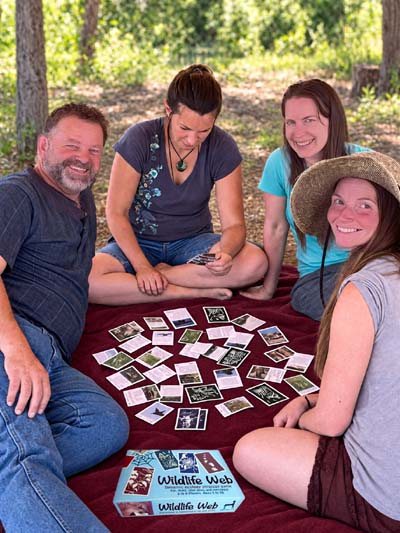
From grade school through college, our education system is heavily lecture-oriented, where knowledge tends to flow in one ear and out the other. Educational games can transform learning into a more engaging and interactive experience, where learning is fun and mastery brings immediate dopamine rewards. Whether playing with friends, homeschooling, or in the classroom, quality nature education games offer an exhilarating option for serious learning.
Author and educator Thomas J. Elpel revolutionized plant identification with the patterns method of plant identification, first with his book Botany in a Day, and later by distilling core concepts in story form through Shanleya's Quest: A Botany Adventure for Kids Ages 9 to 99. Turning these patterns into games was the next logical step. Through addictive games like Memory, Slap Flower and Wildflower Rummy, players of all ages quickly master the core traits to identify 45,000+ plants to the proper families.
Tom later applied similar game-playing magic to teaching wildlife ecology with Wildlife Web: A Dynamic Ecology Strategy Game. Players plunge into a surprisingly accurate model of the ecosystem where they role-play any of fifty different animals, from bison to badgers, to forage, hunt, or scavenge food to survive, find a mate, and raise offspring.
More than just learning, games divert people from screens, bringing friends and families back together for shared laughter and a renewed sense of connection. Are you ready for some family fun?
Click game covers for more information and package discounts.
Download our current HOPS Press LLC Retail Catalog (PDF)
 |
Shanleya's Quest (Card Game 1)
Patterns in Plants Card Game
By Thomas J. Elpel
The Patterns in Plants Card Game is a fun way to test your skills at identifying the family patterns described in Shanleya's Quest. Learn to see the patterns in the game. Then you will be able to recognize them in the real world! Many different plant identification games are possible with this deck of cards. [Read more...] |
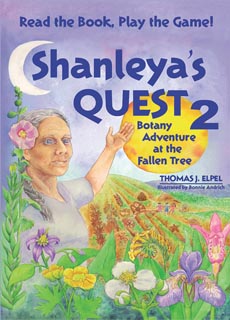 |
Shanleya's Quest 2 (Card Game 2)
Patterns in Plants Card Game
By Thomas J. Elpel
The Patterns in Plants Card Game is a fun way to test your skills at identifying the family patterns described in Shanleya's Quest 2. Learn to see the patterns in the game. Then you will be able to recognize them in the real world! Many different plant identification games are possible with this deck of cards. [Read more...] |
 |
Wildlife Web
A Dynamic Ecology Strategy Game
By Thomas J. Elpel
Can you hunt or forage, find a mate, and raise your young... all without becoming someone else's lunch? Welcome to Wildlife Web, the exhilarating ecosystem strategy game where you participate in the web of life! Wildlife Web simulates the dynamics of a real world ecosystem with astonishing accuracy in a game. With fifty animals to choose from, players can become anything from a bird to a bear, each foraging or hunting for food to mate and reproduce while trying not to become food themselves. The game is fun, competitive, and addictive!. [Read more...] |
Hello,
I'm returning to your website of merchandise after 8 years, at which time I purchased a copy of Wildlife Web for my unborn child, thinking it would be a good way to teach ecology to them later on and finding limited options available. I now have two children and in the past couple years they've become old enough to play and appreciate the game and it is a family favorite that also teaches a lot of good ecological lessons. I'm sure your other items will be similarly valuable in my own quest for useful education of my offspring.
Best regards and appreciation for the work that you do,
Rob
The Story Behind our Games

Learning is good. Having fun playing games while learning is even better. Thomas J. Elpel's interest in games evolved from leading plant identification walks. It is easy to talk and talk and talk about plants, but as they say, "What comes in one ear goes out the other." There had to be a better way.
 As the author of Botany in a Day: The Patterns Method of Plant Identification, Tom started teaching students to recognize plant family characteristics, giving them powerful tools to recognize new plants. With these tools, his students could immediately tell him a great deal about plants they encountered, even if they had never seen them before.
Core principles from Botany in a Day were distilled into a fun and magical story for children in Tom's book Shanleya's Quest: A Botany Adventure for Kids Ages 9 to 99. True to the title, even adults can learn a lot from a children's book!
 Writing Shanleya's Quest led to development of the Patterns in Plants Card Game, providing an easy means to practice recognizing plant family patterns. With the game in hand, it is possible to introduce the basic patterns for identifying eight plant families covering about 45,000 species in ten minutes or less. Students internalize those plant family patterns at a deep intuitive level by playing games like Memory, Slap Flower, Crazy Flowers, Wildflower Rummy, or Shanleya's Harvest.
Astonishingly, kids who entirely miss the plant families introduction quickly absorb the patterns by merely watching the games and jumping in. And that's the true power of games. Without sitting through a lecture, kids can grasp the fundamentals of plant identification. They gain skills to instantly recognize plants in any wildflower meadow or garden bed, without actively thinking about it. Check out Shanleya's Quest!
As an educator, Tom learned that "less is more." Why bore people with lectures when they can learn by playing games? That led to an interest in actively developing additional educational games.
 Tom's newest game, Wildlife Web, was inspired after playing Pokémon card games with his son. At twelve year's old, Tom's son knew the life history of every Pokémon and all their special powers. That got Tom thinking, "Wouldn't it be great if kids were equally excited to learn about real animals?"
Although there are some vague similarities, Wildlife Web is vastly different from Pokémon. While Tom thought he might produce the game in just a few weeks, it actually took several years to develop and refine Wildlife Web into a world-class product.
Wildlife Web simulates the dynamics of a real world ecosystem with astonishing accuracy in a card game. With fifty animals to choose from, players can become anything from a mouse to a moose or a bird to a bear, each foraging or hunting for food to mate and reproduce while trying not to become food themselves. The game is fun, competitive, and addictive!
In the process of playing Wildlife Web, players learn about each of the animals: What do they eat? What are their strengths and weaknesses? What special skills or abilities are unique to each species? Which animals are diurnal, nocturnal, or crepuscular? What natural hazards do they face? How does human activity impact their world? The game even teaches bird language basics, and players can rely on bird allies to protect their animals from predation.
In short, Wildlife Web is like taking a wildlife biology / introductory bird language course while having a riotous good time playing games. Anyone who plays the game can't help but want to learn more. The game has the potential to inspire a deeper nature connection for anyone who plays it. Try it out for yourself!

Learn more about Wildlife Web!
Shopping for birthdays, holidays, resale, or the classroom?
Click Here for Instant Wholesale Discounts!


 HOPS Press LLC